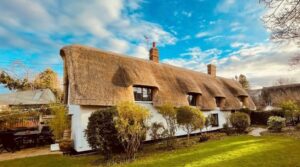
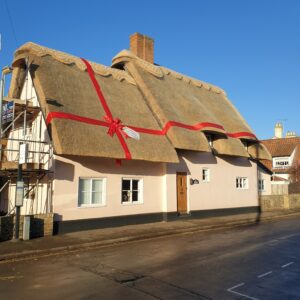
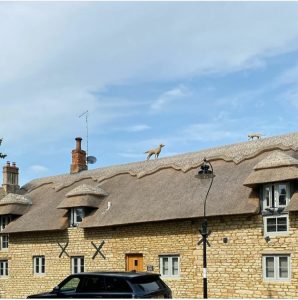
 Thatched roofs aren’t just charming old-fashioned relics; they’re also a surprisingly eco-friendly and practical choice for the modern homeowner. With an estimated 60,000 thatched homes across the UK, people are starting to appreciate the enduring appeal of thatch and its many natural benefits. Homeowners with a sense of adventure and a love of sustainable living prize thatched roofs not only for their storybook charm but for their real eco-friendly benefits like lower energy bills and a reduced carbon footprint. From cost-effective natural materials and exceptional thermals to leaving a minimal footprint throughout their lifespan, thatched roofs have plenty to offer. So, let’s take a closer look at the sustainable benefits of thatched roofing and why this traditional craft is so popular among eco-conscious homeowners.
Built Using Abundant, Natural Materials
One of the biggest eco-friendly advantages of thatched roofing is its use of abundant, plant-based materials. Thatch is made mainly from straw or water reeds, simple grasses that grow fast and can be harvested and replanted without causing much environmental damage. Unlike modern roofing which may rely on finite resources or energy-intensive products like concrete or metal, thatch materials come from nature. Straw is often a by-product of grain farming, and water reeds a natural wetland plant, and using them for roofing gives them another use.
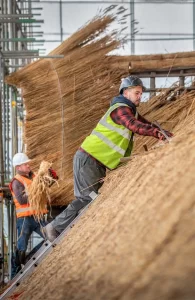
The beauty of these natural materials is that they need next to no processing like factory-made roofs. Thatching is just a matter of applying bundles of dried vegetation to a roof, secured with wooden or steel pegs, none of the high-temperature manufacturing or chemical treatments that many modern materials need. The result is a roof sourced from the natural world with a much lower energy input. And the production and transport energy needed for traditional thatching materials is typically far less than for concrete, clay tiles or metal roofing. Many thatching projects get their materials from local farms, often within the same county or region, which makes them low-carbon and supports local rural economies. For example, a skilled thatcher in Dorset might use wheat straw from the fields next door and wooden pegs from the local copse. This means the supply chain is kept short and the carbon footprint is tiny. (And unlike modern roofing products which often travel long distances or rely on global supply chains)
Using locally grown thatch also means the material is naturally suited to the local environment and readily available. New crops are always sprouting up, so that’s a sustainably replenishable resource. Even if water reed is not locally abundant and needs to be imported, as sometimes happens in the UK when demand outstrips supply, its ecological impact is still relatively low compared to super-processed building materials. So thatched roofs are a genuine homegrown option, embodying a natural approach to building that looks to the future.
Superb Natural Insulation & Lower Energy Bills
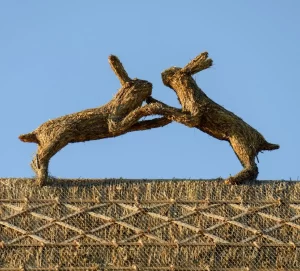 And then there’s insulation, something modern homeowners love. Thatched roofs are brilliant at keeping the heat in, which is a real bonus in cold weather. A well-built thatched roof is usually about 12 inches (30 cm) thick with tightly packed straw or reeds, that’s a killer combination for trapping warm air. This natural insulation keeps the house comfortably warm and cool in equal measure, with experts saying a good thatch is way more effective than other traditional roofs. Homeowners find they need less artificial heating in the winter and less, or even no, air conditioning in the summer. And that means lower energy bills and reduced reliance on fossil fuels.
This natural way to keep the house at a comfortable temperature means a big reduction in energy consumption. Studies and real-world experience show that the insulative properties of thatch can make a real difference to heating bills and electricity for cooling. Straws and reeds have a low thermal conductivity, which means heat doesn’t escape easily. The thick thatch layer slows down heat transfer, keeping warmth in in the winter and blocking hot sun in the summer. So, the household uses less gas, electricity and fans, which not only saves cash but also reduces the carbon footprint. This is a real win for energy efficiency. Another benefit of thatch is that it offers soundproofing, not just insulation. The spongy, fibrous roof is a lot better at muting outside noise (the wind, rain, you name it) than a thin layer of slates or metal sheets ever could be. And besides the fact that it’s comfortable, it adds to indoor peace and quiet without needing any extra machinery or materials. And unlike those synthetic insulations that involve foam or mineral wool, the insulation in a thatched roof is built right into the natural material. No need to add bulky insulation batts, the roof itself is the insulation layer! A thatched roof creates a comfortable living environment, all without needing much more than some smart construction and natural fibres.
Low Carbon Footprint (Embodied Carbon & Carbon Sequestration)
When it comes to thatched roofs, the carbon footprint is pretty darn low. For a start, the plant materials they use means the embodied carbon is minimal, not a lot of CO2 gets spewed out in producing and transporting the material. Thatch roofs don’t need high-temperature kilns or intensive manufacturing processes like concrete tiles or metal panels do. Drying and bundling straw or reed is a pretty energy-efficient process, especially if you do it nearby. And if thatch materials are sourced close by, transportation emissions are tiny. Some eco-maverick thatchers even say they source “everything within 50 miles” for a project. That’s a hell of a lot less CO2 output than roofing that gets shipped from one end of the country to the other, or made overseas.
But thatch has another trick up its sleeve, carbon sequestration. See, when plants grow they suck up carbon dioxide from the air. And the straw and reeds that get used in thatching have spent an entire season (or a couple of seasons) pulling CO2 out of the atmosphere and storing it in their fibres. When these plants become your roof, that carbon stays locked away in the thatch, for the life of the roof. Which means a thatched roof is a bit like a carbon bank, keeping that CO2 out of the atmosphere for decades. Other roofing materials just can’t compete with that. Tiles or metal sheets don’t have the ability to offset their production emissions in the same way.
Putting low embodied emissions together with carbon sequestration means thatch can be close to carbon neutral, or even carbon negative, over its lifetime. One study by a master thatcher said traditional straw thatching of an existing cottage is “one of the most green” construction projects because, well, everything is biodegradable and potentially carbon-neutral if you use local materials. Just remember, if you’re importing reeds from far away, that adds to the carbon footprint. But even in those cases the CO2 emissions tend to be lower compared to modern roofing alternatives. For a really green thatching experience, homeowners can opt for locally grown wheat reed or long-straw thatch, meaning the lowest possible carbon impact for their roof.
Biodegradable & Low-Waste Lifecycle
At the end of its life, a thatched roof is as eco-friendly as it is when it’s brand new. All the main components, straw, reed, heather, or other natural fibres, are fully biodegradable. So, when a thatched roof eventually wears out, the old thatch can be returned to the earth rather than getting hauled to a landfill. In many cases, removed thatch is simply composted on-site or nearby. Over time it breaks down into organic matter that can be used to enrich gardens or fields. Which is a pretty sharp contrast to the way conventional roofing waste gets treated. Old asphalt shingles, for example, are basically toxic landfill material, they can last for centuries. Broken clay tiles or concrete slates are inert waste that has to get carted off. Thatch waste is basically just mulch; it gets to safely reintegrate into the natural cycle.
The low-waste advantage of thatch isn’t just limited to full roof replacement. Thatch roofs typically get renewed in sections, the ridge might get replaced every 10-15 years, and the main thatch coat can last several decades before needing replacement. Old ridge straw that comes off during maintenance can get composted or left to biodegrade, avoiding any significant waste streams. Even the wooden pegs (hazel spars) used to secure thatch will rot away harmlessly if you remove them. In short, nearly 100% of a thatched roof’s materials are recyclable or biodegradable. Which gives thatch a big leg up in terms of waste reduction. The construction industry is pretty plagued by waste from demolitions and renovations, but thatched roofs are a refreshing exception, they don’t contribute to long-term waste problems. Furthermore, because thatched roofs are often fixed on site by adding new material on top of the old, this means they get less frequent full overhauls where the whole roof has to come off. A thatcher will usually add fresh layers on top of solid older thatch, and only take off the really rotten bits when they need replacing. This ‘layering’ technique, by the way, is a very sensible way of doing things: instead of chucking out the whole roof every time it needs a makeover, you’re reusing what’s left and just topping it up or replacing the bits that are wearing thin. So, thatch embodies that whole ‘reduce, reuse, and recycle’ thing pretty neatly and in a very real way, especially at the end of the roof’s life when even the bits that do get ripped out just get sent back to nature without causing any problems.
Supporting Biodiversity and Living in Harmony with the Environment
Having a thatched roof can have some pretty positive knock-on effects for local wildlife. Unlike hard, flat roofs that just don’t invite any life to stick around, thatch creates a more natural environment on top of a house. The little nooks and crannies between the straw can become a shelter for small creatures. Birds and bats have been known to roost under the eaves, using the roof as a handy hideaway. All sorts of insects can get a home in the thatch too, which is great for the local ecosystem. Now, I’m not saying you want a roof overrun with pests, but if you’ve got a healthy thatch and the right sort of critters, say solitary bees or lacewings, they can actually be good for your garden by helping with pollination.
Choosing a natural roof like thatch can give eco-conscious homeowners a real feeling of satisfaction, like their house is part of the landscape, not some artificial thing stuck out in front of it. Thatched properties just fit in with the countryside so well, both visually and in terms of how they operate.
Thatch roofs are porous, so when it rains the water just trickles off slowly and gets absorbed into the ground like it would with natural vegetation, which cuts down on all the storm water runoff problems you get with hard roofs. When it’s hot, thatch doesn’t blast out heat the way some other types of roofs do, so it doesn’t contribute to those urban heat island effects. Even the colour of a thatched roof, a soft, natural golden brown, is non-reflective and earthy, which means it doesn’t cause any light pollution or glare. In its own quiet way, thatch just works in harmony with the local environment. And in a funny way, it turns your house’s roof into a bit of nature too, a ‘living roof’ before green roofs with actual plants became all the rage.
Of course, homeowners do need to take some sensible precautions to make sure the critters in the thatch don’t become a problem. Adding some wire mesh in the ridges can stop birds from making a mess, and using natural, safe repellents can keep those pesky insects at bay. Generally, though, a well-maintained thatch won’t be home to any big pests. Any little bit of wildlife you do get, like small birds or useful insects, is usually just seen as a bonus by people who care about nature.
Longevity and the Benefits of Low-Impact Maintenance
Some people reckon thatched roofs are short-lived or a bit flaky, but actually a well-maintained one can be very long-lasting. And this durability has got its eco-benefits too. A well-built water reed thatch might last 40 to 50 years or more before needing to be fully replaced, while wheat straw thatch can last 20-30 years on a well-maintained roof. Importantly, the foundation of the roof (like the rafters and old base layers of thatch) can last an absolute age, often over a century. There are roofs in England that have been thatched on the same old structure for over six hundred years. So, what happens is the roof gets gradually renewed over the years, rather than being ripped out and started from scratch all the time, a pretty powerful example of how you can build in sustainability. During a thatched roof’s lifetime, maintenance is done in short instalments. Homeowners replace the ridge every decade or so, fix small rips, and slap on new layers when needed, rather than ripping the whole thing off all at once. This piecemeal maintenance minimise’s the resources used at any one time. When you replace a worn out patch of thatch, you’re only using a handful of straw bundles to patch it up, a lot smaller material input than retiling an entire roof section. And, as we mentioned, the old thatch gets composted, not sent to the dump. The gradual maintenance cycle of thatched roofing means fewer spikes in material use and waste generation over the building’s lifetime. Instead of being ripped out and replaced en mass, the roof is a living element of the house, evolving gradually and getting refreshed as needed. This is in stark contrast to a lot of modern roofs, which get completely yanked off and redone every few decades, generating a ton of waste and carbon costs in one hit. With thatch, repairs are a form of composting, extending the roof’s life with hardly any environmental cost.
It’s also worth noting that the craftsmanship involved in thatching goes a long way in reducing the environmental impact. Thatching is done by skilled hand labour rather than heavy machinery. This traditional, labour-intensive process substitutes human skill for high energy inputs. While labour alone doesn’t make a roof “greener”, it does mean that upkeep of a thatched roof supports local skills and employment, and helps foster sustainable communities. And a well-maintained thatch does more than just get the eco- nod, it actually helps protect the house beneath it, stopping weather damage and keeping the whole building in good nick, which is inherently greener than letting them fall to ruin and building new ones. By putting in the effort to keep a thatched roof in good shape, owners of thatched houses make sure it gets the longest lifespan possible, further spreading out and reducing any environmental costs along the way.
A Roofing Tradition with Modern Eco Charm
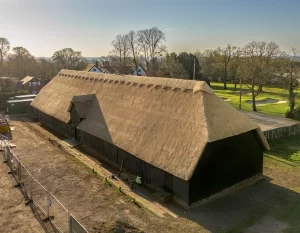 Thatching has been around for ages, but it somehow fits perfectly with 21st century eco values. As more and more homeowners look for ways to reduce their environmental footprint, thatched roofs have seen a resurgence. Britain’s thousands of thatched cottages are no longer viewed as quaint relics of the past; in fact, many buyers and builders now see thatch as a genuinely eco-friendly choice. With an estimated 60,000 thatched properties in the UK, not just old houses but new builds too, there’s a growing appreciation for the fact that traditional materials and techniques can offer real-world solutions to modern environmental problems. Thatch, with its natural insulation and renewable sourcing, is a prime example of old wisdom meeting green living.
For the eco-conscious homeowner, a thatched roof can be both a lifestyle statement and a practical improvement. It signals a commitment to living sustainably and a respect for natural materials. At the same time, it gives you some really tangible benefits, from lower energy bills to a healthier house to live in (thanks to the breathability of thatch, which avoids the condensation issues some sealed modern roofs have). Plus, a thatched roof gives a home a one-off character and connects it to local heritage, which can be a real emotional draw for some. In an era of climate change and resource concerns, thatched roofing stands out as an eco-friendly option that has stood the test of time. By using natural resources and working with the principles of nature, thatching creates beautiful roofs that leave barely a footprint on the planet.
Thatch is probably the very first “green roof”, long before the term was even thought of, since it’s made of growing green material and seamlessly integrates with the environment. The eco-friendly benefits of thatched roofing are numerous: it uses natural, renewable materials; provides fantastic insulation for energy savings; has a tiny carbon footprint, with the a
dded bonus of some carbon sequestration; and at the end of its life, it biodegrades without causing any pollution. A thatched roof also complements the natural ecosystem and
keeps alive a sustainable building tradition. For homeowners trying to live more sustainably and in harmony with nature, a thatched roof is more than just a rustic cap for a cottage, it’s a practical, proven way of building a home the sustainable way. By embracing thatch today,
you’re embracing a roofing choice that is beautiful, tried-and-tested, and really kind to the environment. Any eco-conscious builders or renovators would do well to have a look at the old straw roof, it might just be the cutting edge of green home design that’s hiding in plain sight